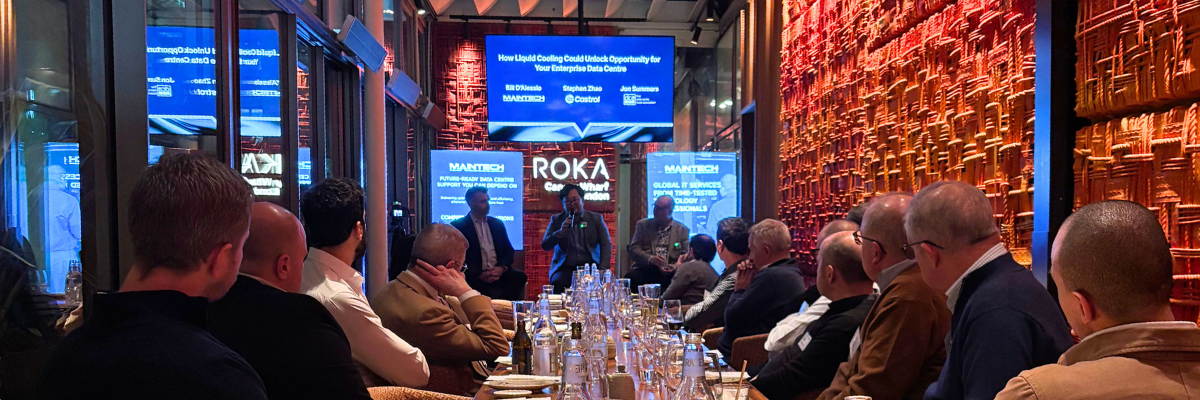
On January 22, 2026, Maintech hosted LC26, bringing together enterprise IT leaders and industry experts to unpack one of the fastest-moving challenges in modern infrastructure: liquid cooling.
Rather than a sales-led discussion, LC26 was designed to be a practical, peer-level conversation about where liquid cooling fits today — and where it’s heading next.
Expert Perspectives from Across the Industry
The session was hosted by Bill D’Alessio of Maintech, who opened the discussion by framing why liquid cooling has moved from a future concern to a present-day consideration for enterprise and hyperscale environments alike.
Attendees also heard from Dr. Jon Summers of RISE (Research Institutes of Sweden), who brought a research-led perspective on densification, thermal limits, and the real-world misconceptions surrounding liquid cooling efficiency and sustainability.
Rounding out the panel was Stephen Zhao from Castrol, who shared practical insight into how liquid cooling projects are being implemented today — including lessons learned around fluid management, operational maturity, and long-term system reliability.
Liquid Cooling Is No Longer Niche
A clear theme throughout the evening was that liquid cooling is no longer reserved for supercomputing or research environments. With AI workloads, GPU density, and power constraints accelerating, many organizations are now being forced to consider liquid cooling as a practical requirement, not a future experiment.
The discussion explored why air cooling still has a role to play, but also why hybrid environments — mixing air, direct-to-chip, and immersion — are quickly becoming the norm.
It’s About Density, Not Just Efficiency
One of the most important takeaways was that liquid cooling adoption isn’t driven purely by sustainability targets or efficiency metrics. The real pressure point is densification.
As compute workloads become more intense, traditional air-cooled designs struggle to keep pace — especially when rack densities push beyond familiar limits. Liquid cooling offers a way to support higher-density workloads while maintaining performance and hardware longevity.
Operational Readiness Matters as Much as Technology
Beyond the technology itself, LC26 highlighted a growing focus on operational readiness. Liquid-cooled environments introduce new considerations around maintenance, monitoring, training, and lifecycle planning.
The consensus? Organizations don’t just need the right cooling architecture — they need partners who understand how to support, service, and scale these environments over time, without adding operational risk.
A Maturing Ecosystem
Perhaps most encouraging was the sense that the liquid cooling ecosystem is maturing quickly. Standards are improving, best practices are emerging, and early misconceptions around reliability, sustainability, and maintenance are being actively addressed.
For organizations considering their next infrastructure decision, the message was clear: now is the right time to start planning.